How to Check a Property Price Against the DGI Scale
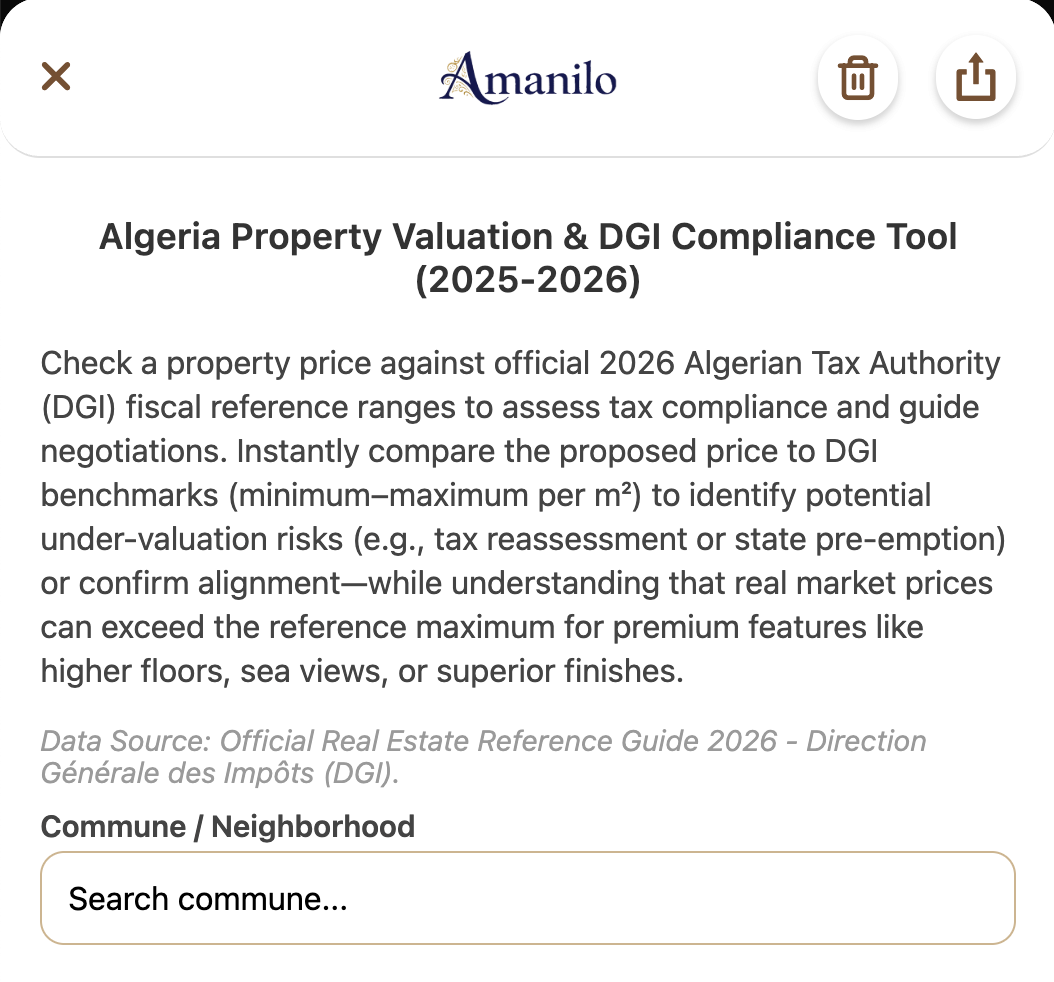
If you are buying in Algeria from London, Montreal or New York, there is one question your notary will not always raise for you: could the price written in the deed be challenged by the tax authority? The answer lies in the property price reference scale published by Algeria's Direction Générale des Impôts (DGI). The hard part is knowing which box your property fits in.
This guide walks through each input step by step, explains how to read the result and what to do next. To get the range for your municipality straight away, use the tool:
Why the declared price matters
For each municipality, the scale sets a minimum and maximum price per square metre. The tax authority uses it to assess the price written in the deed, which is the basis for registration duty. When the declared price is well below the minimum, there are two risks:
- Tax reassessment (redressement fiscal): the authority revalues the sale and claims additional duties, possibly with penalties.
- State pre-emption: in some cases, the State can buy the property at the under-declared price.
Sellers sometimes suggest declaring less "to save on fees". It is usually the buyer who carries the consequences.
Step 1: the municipality
The scale is set by municipality (commune), not by neighbourhood. Look up the property's administrative municipality, which is not always the name people use: in Oran, for example, Belgaïd, Millénium and Haï Es Sabah all belong to the municipality of Bir El-Djir. The tool currently covers the municipalities of Algiers and Oran.
Step 2: apartment or villa
The scale separates collective housing (apartments, including duplexes in a building) from individual housing (villas and houses). A villa has different ranges from an apartment of the same size in the same municipality.
Step 3: the standing category
This is where most mistakes happen. Picking a lower category to bring the tax floor down offers no protection: the notary and the tax authority judge the property for what it is. Practical guidelines:
- Standing (high end): recent, good-quality construction, careful finishes, central heating or built-in air conditioning, a lift, underground parking and security in the residence.
- Amélioré (mid-range): modern reinforced-concrete construction, decent finishes, aluminium or PVC windows, individual heating; most recent buildings without high-end services.
- Économique (basic): AADL, LPP or OPGI housing and developments with basic finishes, where heating and air conditioning are often installed by the buyer.
- Précaire (substandard): old or badly degraded buildings without modern comfort, such as some buildings in historic centres.
Step 4: the zone
Within one municipality, the scale distinguishes the residential zone, the city centre and the peripheral zone, and the gaps between them are significant. If you are unsure, ask the notary which zone they will use: theirs is the one that counts in the deed.
Step 5: the floor area
Use the area stated in the seller's deed, not the one in the listing. Some listings give a total area including terraces or outdoor space, while the deed records a different figure. A 20 m² error changes the tax value by several million dinars.
Step 6: the price to declare
Enter the total price you will actually write in the deed. The tool compares it with the range that matches your choices and floor area.
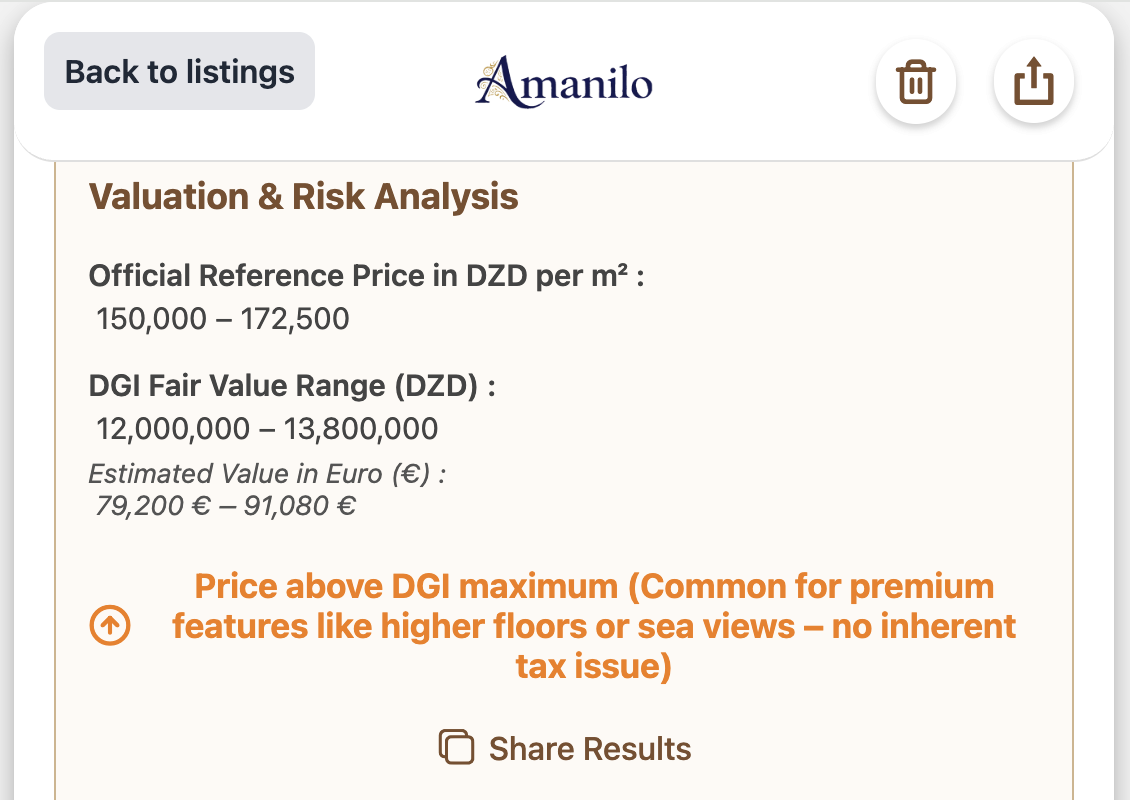
Reading the result, and what to do next
- Below the minimum: tax risk. First check your inputs (standing, zone, floor area). If they are right, do not sign at that declared price: renegotiate, or declare the price you actually pay.
- Within the range: the price complies with the scale. Your notary still calculates the exact duties.
- Above the maximum: common for sought-after properties (sea view, popular residence, large floor area). No under-valuation risk; it simply shows the market sits above the tax floor.
The tool also shows an approximate conversion into euros to help you compare from abroad.
Worked example: an F4 in Bir El-Djir, Oran
Take a 120 m² F4 apartment (three bedrooms), Standing category, in the residential zone of the municipality of Bir El-Djir. The 2025-2026 scale sets a range of 139,000 to 159,000 DZD per square metre, a tax value between 16,680,000 and 19,080,000 DZD.
- The agreed price is 26,000,000 DZD: above the maximum, which is common in Bir El-Djir's sought-after residences. No tax risk.
- The seller suggests declaring 15,000,000 DZD "to cut costs": that is below the 16,680,000 DZD minimum. This is exactly the situation that exposes you to a reassessment, or even pre-emption.
The most common mistakes
- Treating the DGI scale as the market price: it is a tax floor, not a valuation.
- Using the neighbourhood name instead of the administrative municipality.
- Using the listing's floor area instead of the deed's.
- Choosing a lower standing category than the property deserves to bring the minimum down.
- Accepting an under-declared price because "everyone does it".
Frequently asked questions
The seller suggests declaring a lower price at the notary. What is the risk?
If the declared price is well below the DGI reference minimum, the tax authority can reassess the sale, and in some cases the State can exercise its pre-emption right at the declared price. The buyer often carries that risk. Declare the price you actually pay.
Which category applies to an AADL or LPP apartment?
AADL, LPP and OPGI homes usually fall under the Économique category unless they have been substantially upgraded. If in doubt, ask the notary which category they will use in the deed.
Are DGI reference prices the market price?
No. They are tax valuation ranges. In many districts of Algiers and Oran, actual prices sit above the top of the scale, which raises no tax issue.
Is the Amanilo tool an official DGI service?
No. It is an independent information service based on the reference scale published by the DGI. It does not replace official verification or a notary's advice.
Check my price with the DGI tool
Results are for information only. Always check the current reference prices on mfdgi.gov.dz and consult your notary before any transaction. Questions or feedback about the tool? Email us at hello@amanilo.com.